
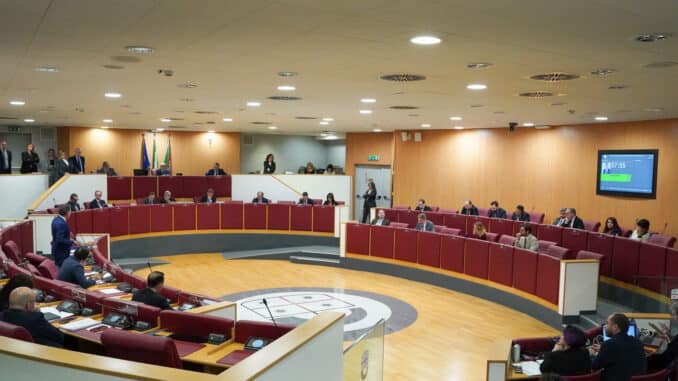
During Thursday’s session of the Ligurian Regional Council, a discussion took place on the Government Programme for the 12th Legislature presented by President of the Regional Council Marco Bucci in the session of Tuesday, 3rd December.
Armando Sanna, leader of the PD group, criticised the programme, describing it as “a shopping list” and “a government of schizophrenia” that shows “an inability to decide.” The group leader also noted that some ongoing projects are experiencing delays, particularly mentioning the motorway bypass, the new port dam in Genoa, and the Aurelia bis. Sanna also expressed strong criticism of the establishment of the delegated councillor role, “a non-existent figure, assigned heavy responsibilities such as economic development, craftsmanship, industry, logistics, the Blue Economy.” He dedicated part of his speech to the waiting lists for healthcare services: “Can we ask – he asked the President of the Council – that by 12 March the waiting lists improve by 15% and at least a quarter of the necessary new hires be completed?” After highlighting other issues related to support for families for childbirth, social welfare, education, and the depopulation of inland areas, he added: “Infrastructure is essential, yet we witness the daily disaster of mobility in Liguria.” Other topics addressed included employment and poverty levels. “The data I have outlined demonstrate that the situation is dire, and we have a duty to act. For this reason, we will conduct a civil, serious, and rigorous but very tough opposition. However, if the majority wishes, we will be there to achieve tangible results for Liguria, whose well-being guides us every day.”
Selena Candia, president of the Green and Left Alliance group, highlighted the issues in Liguria, which relate to healthcare, waiting lists, the brain drain, and social emergencies. “The problem,” she said, “is not that there is no money to recreate the welfare state and services that once existed.” Candia added, “The programme does not mention public healthcare, yet only the public system managed the pandemic emergency.” She expressed strong criticism of the mention of an incinerator in the council’s programme and emphasized the need to produce energy from renewable sources and to support energy communities. “Differentiated autonomy has been dismantled by the Constitutional Court and in Liguria,” she added, “it could cause damage because significant funding cuts are expected, especially in education.”
Gianni Pastorino, president of the Andrea Orlando Presidente group, emphasized the priority of the Legislative Assembly’s autonomy. The councillor shared concerns about the public health system, as highlighted by Candia, stating, “It is still unclear what the deficit in healthcare is, which was produced by previous centre-right administrations, making it difficult to organize staff recruitment by health companies.” Pastorino called on President Bucci for planning and coordination of healthcare policies. The councillor hoped for a thorough debate between the Council and the Executive on healthcare policies and expressed doubts about the creation of the Ligurian Health Superior Council, which would add to other already existing and heavily criticized structures.
Stefano Giordano, president of the 5 Star Movement group, urged President Bucci to pay greater attention to the infiltration of organized crime. Referring to the program, he stated, “There are doubts about the actual feasibility of what has been declared, for example, regarding the reduction of waiting lists, and I request clarification on the costs of certain administrative structures,” specifically mentioning the costs of ALiSa. Giordano proposed to President Bucci to conduct a joint inspection of Ligurian hospitals on December 27th, a period when staff shortages are more significant. Criticisms were also expressed about the projects to transfer chemical depots to Sampierdarena and the second cremation facility in Staglieno.
Federico Romeo (Pd) highlighted the inconveniences caused in the Genoa neighborhoods of Valpolcevera by the Terzo Valico construction sites. Romeo also pointed out the uncertainties regarding the project and funding for the Gronda, the delays in building the new breakwater dam in the port of Genoa, and requested an immediate discussion in the relevant council committee about the Genoa railway junction.
Enrico Ioculano (Pd) stated, “The program lacks a clear political vision on managing the healthcare situation and, more generally, lacks strategies and actions to achieve government objectives,” citing demographic crisis as one of the emergencies. The councillor noted the need to ensure support for chronic illnesses and criticized the potential allocation of more resources to private healthcare. “The challenge,” he added, “is political, to secure more funds from the government for public healthcare.”
Roberto Arboscello (Pd) stated: “I express concern about the approach, orientations, and initial statements, which seem like an election campaign.” The councillor added: “Liguria does not need a mayor or a commissioner, but a president who engages in dialogue with social partners and workers in institutional forums,” emphasizing the need for a dialectical relationship and clarified: “We would like to understand what organisation will be given to the regional administration.”
Katia Piccardo (Pd) stated: “President Bucci has repeatedly emphasized the need for growth in Liguria in his program, but the prerequisite for growth is the right to health, yet in our region, many people forgo seeking medical care.” The councillor also highlighted the high number of “healthcare escapes” to other regions. Piccardo addressed the issue of daily disruptions in rail transport, which particularly affect commuters, and the hydrogeological instability impacting the inland areas.
Jan Casella (Alliance of Greens and Left) highlighted “the lack of pragmatism in the government’s programme, which is merely a list of projects, not a truly achievable plan.” Casella also referred to the proposal of building an incinerator, criticizing the lack of clarity regarding its location. The councillor pointed out deficiencies in the healthcare system along the Savona coast and in the Valbormida area, urging the president to follow through on promises of interventions for the region.
Carola Baruzzo (Pd) described the president’s programme as “unsatisfactory” regarding its objectives and actions to achieve them. The councillor highlighted the programme’s shortcomings in cultural policies, maintenance of public health facilities, employment policies, and the implementation of the PNRR projects. Baruzzo also emphasized the need for a qualification of the tourist offer “with systemic interventions,” to ensure that any “resulting benefits do not remain in the hands of a few.”
Rocco Invernizzi, leader of the FdI group, defended the government program: “It is the result of careful and precise planning for the future of Liguria, focusing on the healthcare system, social welfare, and business support.” During his speech, he emphasized sustainable tourism: “We are aware that, to be competitive,” he noted, “tourism must evolve, and for this reason, the creation of DMOs (Destination Management Organizations) is one of the strategic policies as it allows for integrated management of tourism resources and initiatives, overcoming territorial divisions and creating a unified image of Liguria that also embraces the hinterland, villages, and natural parks.” Invernizzi added: “With great determination, we are moving forward to complete essential projects like the ‘Gronda’. The Genoa sub-port tunnel, along with the Terzo Valico, represents a concrete solution to improve logistics and the flow of goods, creating new opportunities for our port and the entire Ligurian production system. Doubling the Genoa-Ventimiglia railway line, along with other infrastructural projects like the Albenga-Carcare-Predosa link, are not just necessary works to meet mobility needs but are a concrete response to the growth of our economy and the improvement of the quality of life for all Ligurians.” Invernizzi highlighted the funds recently allocated by the Government and the Region, particularly for the Val Bormida, for the redevelopment of complex industrial crisis areas. “Liguria,” he added, “is the pillar of the Blue Economy in Italy and is set to become a crucial hub for global routes.” Regarding employment, the group leader noted the positive job figures in 2023 and that the regional GDP in the last three years has grown more than the national average and the economy, even compared to other regions. “Young people are resources to make Liguria more dynamic and inclusive, and we aim to harness their skills without them going elsewhere. We believe,” he concluded, “in a future where every Ligurian can be proud of their land.”
Carlo Bagnasco, president of the Forza Italia Berlusconi group, highlighted that the citizens of Liguria have endorsed the centre-right coalition’s programme with their votes: “We want things to be done well, we aim to govern and contribute to our citizens through a comprehensive programme because that’s how it should be. We must start,” he added, “from the common good to provide new opportunities,” and he expressed hope for the minority’s collaboration in achieving these goals. “I have full confidence in this administration, even if there are political decisions made by the president of the council and our coalition that may not appeal to the minority.”
Simone D’Angelo (Pd) criticized the Plan, describing it as an example of “fence-sitting” and “in line with those who preceded Bucci with a region for the few and privileged, a region where, despite the exceptional availability of European funds, there is no real planning.” The councillor also stated that the programme does not address youth and the fight against the mafia.
Davide Natale (Pd) asked President Bucci about the outcome of yesterday’s meeting in Rome with Prime Minister Meloni and Minister Salvini: “We still do not know what the Prime Minister’s response was to the requests from the Regional President, but this is the council of mysteries, as we have not received answers on the dam projects, the ring road infrastructure, or healthcare.”
Chiara Cerri (Forza Italia Berlusconi) responded to the opposition’s remarks regarding the proposed healthcare measures. Referring to a personal experience, she highlighted that the council’s plan includes an integrated system for sharing patients’ health information, which will be networked to particularly assist older patients.
Gianmarco Medusei (FdI) responded to the opposition’s accusations regarding the government program, focusing particularly on the planned initiatives for the healthcare sector. He referred to the criticisms as “instrumental and failing to consider the complexity of public healthcare.” The councillor expressed hope for the commencement of work on the Felettino hospital and the enhancement of home care and elderly care. Regarding long waiting lists, Medusei emphasized that the issue is nationwide.
Armando Biasi (Lega Liguria Salvini) shared his experience as mayor in the chamber and added: “I agree with and endorse the program,” further elaborating on three objectives within the program that are important to mayors: organization, simplification, and transparency, which he stated are essential for good municipal governance. Biasi expressed hope for cooperation with regional minority councillors to achieve these goals.
Angelo Vaccarezza (Forza Italia Berlusconi) highlighted that the centre-right has won the regional elections for the third time, despite the challenges of the recent campaign conducted at a rapid pace amidst an ongoing judicial inquiry. The councillor urged the opposition to engage in constructive rather than prejudicial opposition, as he claimed had been done in the past.
Sara Foscolo, President of Lega Liguria Salvini, responded to the opposition’s accusations, assuring that the intent of the administration and majority is to pragmatically address the issues raised by opposition council members. Foscolo defended the value of establishing the role of the Delegated Councillor, noting that such a role is provided for in municipal administrations, and finally, she expressed hope for the opposition’s collaboration in future council debates.
Veronica Russo (FdI) urged the minority to show greater “institutional responsibility” regarding certain statements made by opposition councillors during the debate. She emphasized the need for pragmatism and promptness in addressing Liguria’s emergencies.
Federico Bogliolo (Vince Liguria) emphasised that the government’s programme aligns with what Marco Bucci stated during the electoral campaign. The councillor highlighted that the government programme mentions numerous priorities: the port dam, bypass, third pass, sustainability, soil protection, businesses, family, sport, and security. Bogliolo recalled that the newly established council has already allocated significant funds for healthcare assistance.
Marco Frascatore (Orgoglio Liguria) responded, particularly to Simone d’Angelo, highlighting the measures taken by the Spezia administration (led by the centre-right, where he served as an assessor) in environmental and urban planning policies. Frascatore invited the opposition to put forward concrete political proposals, assuring his full cooperation.
Alessandro Bozzano (Vince Genova Noi Moderati) assured: “Liguria will be a forward-looking region that leaves no one behind.” Addressing the opposition, he added: “Programs should be assessed before being criticized.” Bozzano further mentioned that in his previous experience as mayor, Marco Bucci achieved significant results for the citizens of the capital.
Matteo Campora, president of the group Vince Genova Noi Moderati, stated: “The centre-right coalition has a unity of purpose and ideas, and the government programme is pragmatic.” Campora highlighted the priority of the circular economy in the programme and reiterated the need to complete the waste management cycle, noting that other regions have also done so. The councillor outlined the process to be followed: “After listening, we move to decision-making and action. This is what we ask of Bucci and the council.”
Giovanni Boitano, President of Orgoglio Liguria, emphasised the necessity of infrastructure: “The Genoa port dam will be a significant project for Genoa, Liguria, and the entire country; the wealth of our region starts with these works.” The councillor highlighted the need to improve the quality of healthcare in Liguria, which is already at the highest levels, and concluded his speech by noting that the programme includes important qualifying interventions for the hinterland.
The President of the Council, Marco Bucci, expressed appreciation for the suggestions received from some opposition councillors and specifically mentioned Jan Casella’s proposals regarding interventions on the Piana di Albenga and support for the disabled: “Councillor Casella gave me two ideas that I consider absolutely important and which were hinted at in the programme, but not in such detail.” The president then referred to the “gate of control” requested by Armando Sanna concerning healthcare waiting lists: “They can provide information, but certainly do not determine whether things are done or not, and our goal is to eliminate waiting lists, but this input is still appreciated,” he clarified. Marco Bucci added: “There is also room in the next 5 years for suggestions, so I renew the invitation to all councillors, my office door is always open, and I promise to give visibility to those who come up with new ideas that were not included in the programme.”