
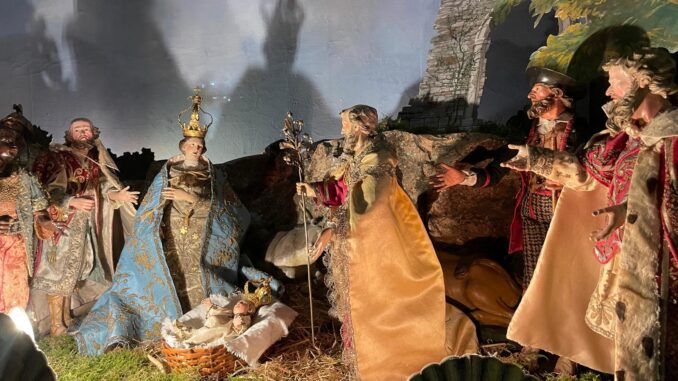
Today, the traditional nativity scene was inaugurated on the ground floor of the palace in Piazza De Ferrari, attended by the President of the Liguria Region, Marco Bucci, and the Archbishop of Genoa, Marco Tasca. The composition, visible from outside, is a historic work from the 18th century, attributed to Pasquale Navone, a pupil of Maragliano. Originating from the Church of San Bartolomeo Apostolo in the Staglieno district, the nativity scene is protected and admired for the quality of its carved figurines and fabric garments. A notable detail is the inclusion of a figure wearing jeans, symbolising the use of this material among the lower classes as early as the 1700s.
Bucci emphasised how the nativity scene represents “an important symbol” for those of faith, as well as an element of Genoese and Ligurian traditions. He also highlighted the significance of the 18th-century Genoese school of nativity art in the national landscape, expressing the intention to continue celebrating and passing on this tradition through the nativity restored by the Regional Laboratory, with the support of the Ligustica Academy of Fine Arts and the Superintendence of Archaeology, Fine Arts and Landscape.
The regional Culture Assessor, Simona Ferro, highlighted that Liguria boasts a rich cultural heritage, with the 18th-century nativity scene being a significant element. She announced the outcomes of the renowned Restoration Laboratory, known for its high standards, and the region’s commitment to cultural initiatives. Among the concrete plans are a public competition for hiring a restorer, followed by another competition for an assistant restorer by 2025, to reopen the laboratory after retirements and to plan new projects across the region, with particular focus on the hinterland.
Archbishop Marco Tasca described the nativity scene as the “heart of Christmas” for Christians, emphasizing its representation of Jesus’s birth and its call for welcoming in daily life. He reminded that, with the approach of the 2025 Jubilee, the Pope invites everyone to be “Pilgrims of Hope,” and the nativity scene offers a tangible vision of divine presence in human history, strengthening the awareness of the hope that arises from the certainty of God’s presence in people’s lives.


