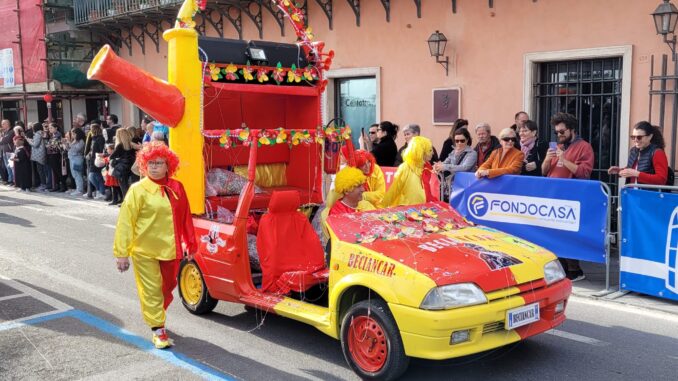
The Ministry of Culture has awarded the Municipality of Loano a grant of 58,181.76 euros for organizing the CarnevaLöa festival, thanks to the Single Fund for Performing Arts, aimed at preserving Italy’s historic carnivals. The funding evaluation considered various factors, including the “historical ranking” of the events. With over 25 years of history, CarnevaLöa scored 80 points, securing the ninth position and one of the most substantial contributions.
For the third time, the Municipality of Loano has received this type of funding. Last year, the funds amounted to 50,115.19 euros, while in 2022, they were just over 16,000 euros. In 2023 and 2024, Loano is the only Ligurian municipality on the list.
Mayor Luca Lettieri and the assessore for tourism and culture, Gianluigi Bocchio, stated: “The CarnevaLöa attracts thousands of visitors annually, making it one of the signature events of our city.” They emphasize that it is not only a tourist attraction but also holds “significant folkloric value,” with origins tracing back to the Renaissance period in Loano. The first festival dates to the late 16th century. The municipal administration expresses gratitude to Vecchia Loano and the municipal offices for their efforts.
The History of CarnevaLöa
Thanks to the support of Vecchia Loano, it has been verified that the first Carnival in Loano dates back to the late 1500s and Giovanni Andrea Doria. A document from 1588 shows that even then, Carnival celebrations were held, with the pre-Lenten desire for fun and satirical spirit expressed through a beloved masked parade, much enjoyed by Prince Giovanni Andrea Doria. It is also clearly documented from the 17th century, according to some notarial acts, the hiring of two or three musicians to accompany the period’s entertainments and play for public dances.
The current “format” of the Loano Carnival boasts over 100 years of history, with various associations having carried on this tradition over time: Unione Sportiva Loanese, Cerchio Rosso, Fetaia, Stella Alpina, Oriental Bluman Carovan, Puè Pepin Association, and the Azienda Autonoma di Turismo e Soggiorno. Since 1992, the association Vecchia Loano has taken the lead, supported by the Department of Tourism, Culture, and Sports of the Municipality of Loano.
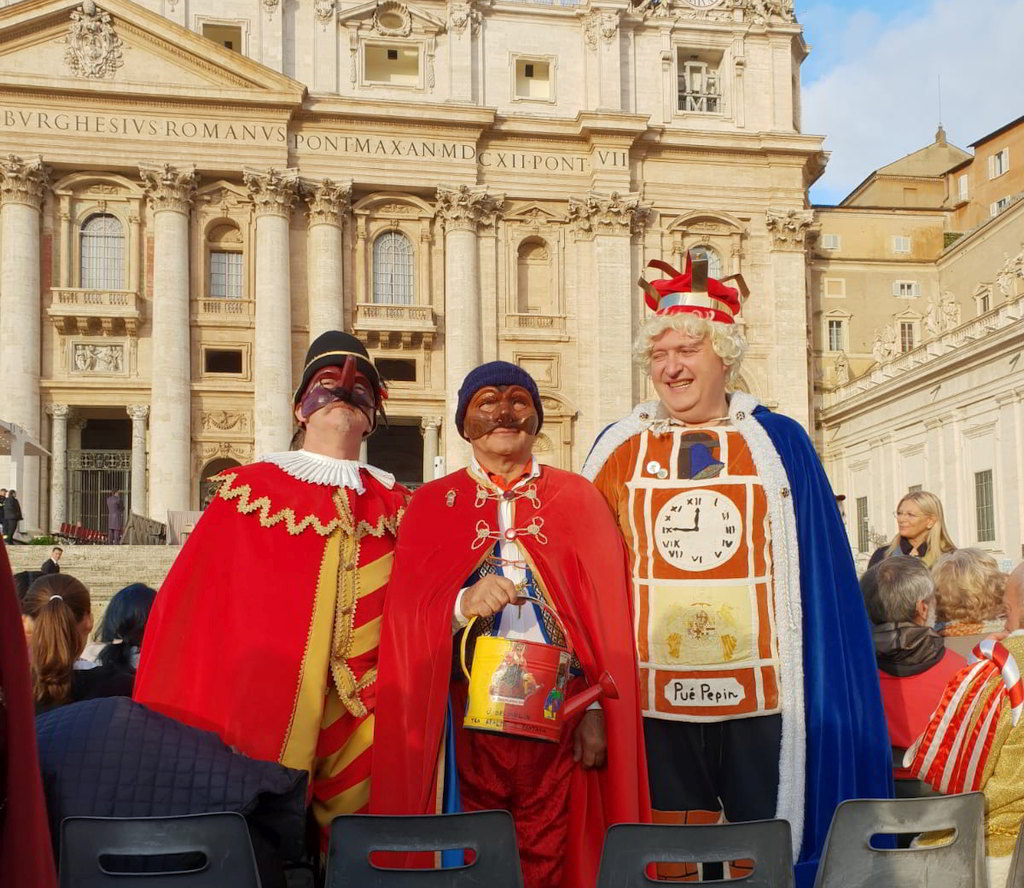
In recent years, the Loano Carnival has been recognized by the Region as the “largest carnival in Liguria” in terms of the number of floats. It features a character from Italian commedia dell’arte, Capitan Fracassa, who, along with Puè Pepin, the King of the Loano Carnival since 1950, and U Beciancin, a jovial character from the early 1900s and the official mask, form a carnival trio now famous throughout Italy. In 2017, CarnevaLöa was acknowledged by the Ministry of Cultural Heritage and Activities and Tourism as a “historical carnival” for its significant role in promoting the region’s tourism for over a hundred years. Therefore, its origins are deeply rooted in history.
The tradition has evolved into the modern era. In the 19th century and up until the early 20th century, it was customary to perform comedies in theaters: initially in a hall located in the city center at Piazza Rocca, then in the municipal theater or the former Cappuccini church. Historical research has revealed that this tradition began as early as 1800, but it was in the early 1900s that the event, enriched by the allegorical floats, became a major popular celebration rooted in its Christian origins.
Vecchia Loano‘s Work
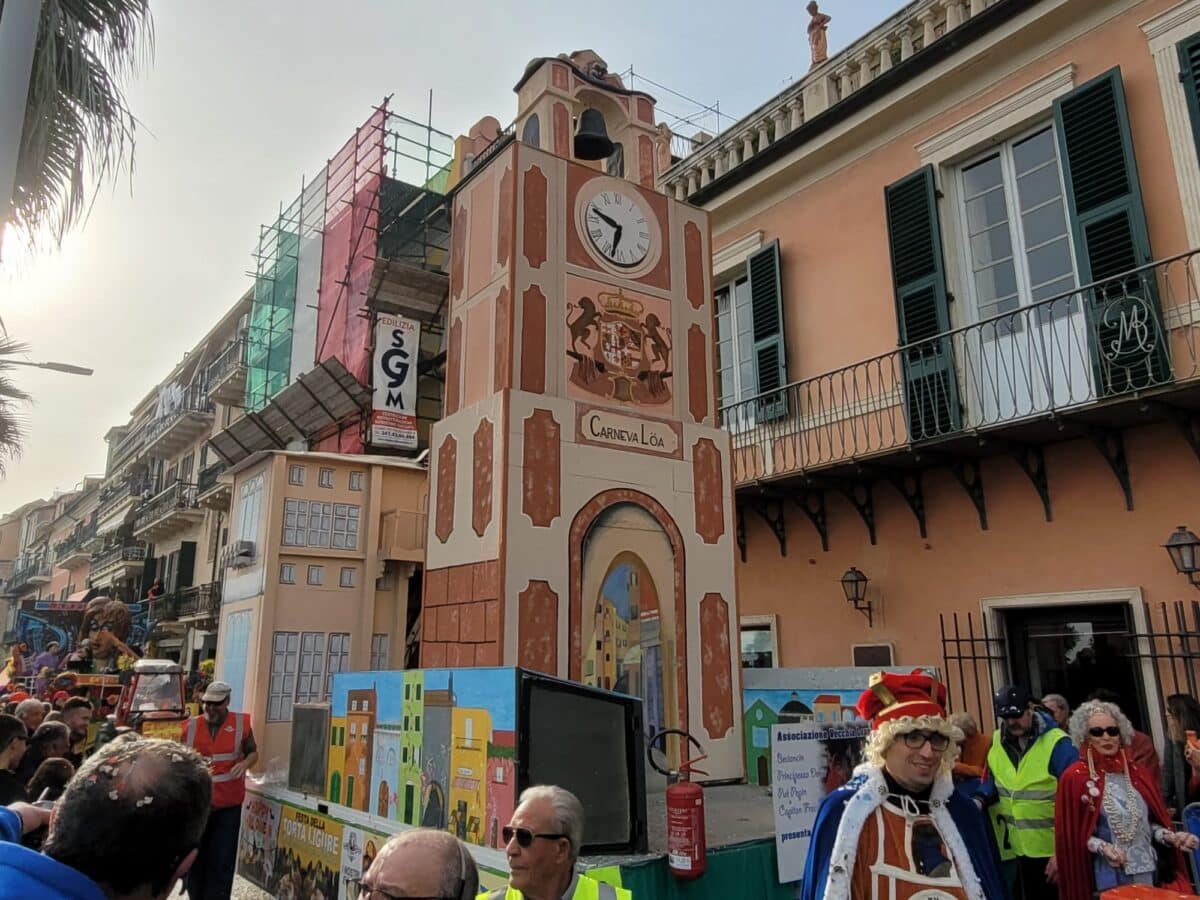
Beyond promoting the organization of CarnevaLöa, Vecchia Loano is engaged in various projects aimed at reviving the city’s historical traditions, not only those tied to carnival but also the sixteenth-century era of the Doria princes and the lore of witches. It is said that since the seventeenth century, esoteric practices were conducted in the Borgo Castello area, home to the oldest Doria residence. To enhance carnival-related events further, the Municipality of Loano has constructed a 1500-square-meter pavilion, the third-largest in northern Italy, where floats are assembled. This space also houses the “papier-mâché school” which, through training courses, promotes the knowledge and transmission of float-building techniques to new generations. In this regard, Vecchia Loano has initiated several workshop activities with local high schools.
Loano, along with Parma, Turin, Vercelli, Castelnuovo Don Bosco (Asti), Busca (Cuneo), Verona, Aosta, Acerra (Naples), Catanzaro, Polignano a Mare (Bari), Sciacca (Agrigento), is a co-founder of the National Coordination Center for Italian Masks. The three masks, Beciancin, Puè Pepin, Capitan Fracassa, and the Princess Doria of the Castle are included in the “Register of Italian Masks,” which catalogs all masks of Italian commedia dell’arte and the folkloric characters from various regional traditions. The initiative aims to elevate the carnival not just as a moment of enjoyment but also as a historical, traditional, cultural, and tourist resource.
In 2019, Vecchia Loano, the Cultural Forum of Borghetto Santo Spirito, and the Pro Loco of Toirano established the “Committee of Historical and Folkloric Ligurian Characters”. Its primary goal is to unite all Ligurian masks under a single “brand” and coordinate the efforts of local associations involved in organizing and promoting the region’s carnivals. Although the Committee serves as a regional reference, it closely collaborates with the Italian Masks Coordination. This vital tool enhances the organization of various Ligurian associations and their associated masks, which now embody more than mere ‘characters’—they carry stories, traditions, and local costumes. The Committee delves into the historical and cultural aspects of existing masks and aims to revive those forgotten, deserving to be reinstated among the Ligurian traditional masks.
On October 14, 2024, the carnival masks of Loano made their debut at the 80th Columbus Day in New York. Capitan Fracassa and Princess Zenobia del Carretto Doria participated in the prestigious parade on Fifth Avenue alongside other Ligurian masks as part of the Italian Masks Coordination Center. The parade represented Italy during the national day commemorating the discovery of America by Christopher Columbus, attended by New York Mayor Eric Adams and Vice President of the Chamber of Deputies Giorgio Mulè. The participation in this event was made possible by the Ministry of Foreign Affairs with Italea and Italy Discovery under the project “The Roots Tourism,” in which the Italian Masks Coordination Center participated.